Introducing Neighbourhood Contact Groups
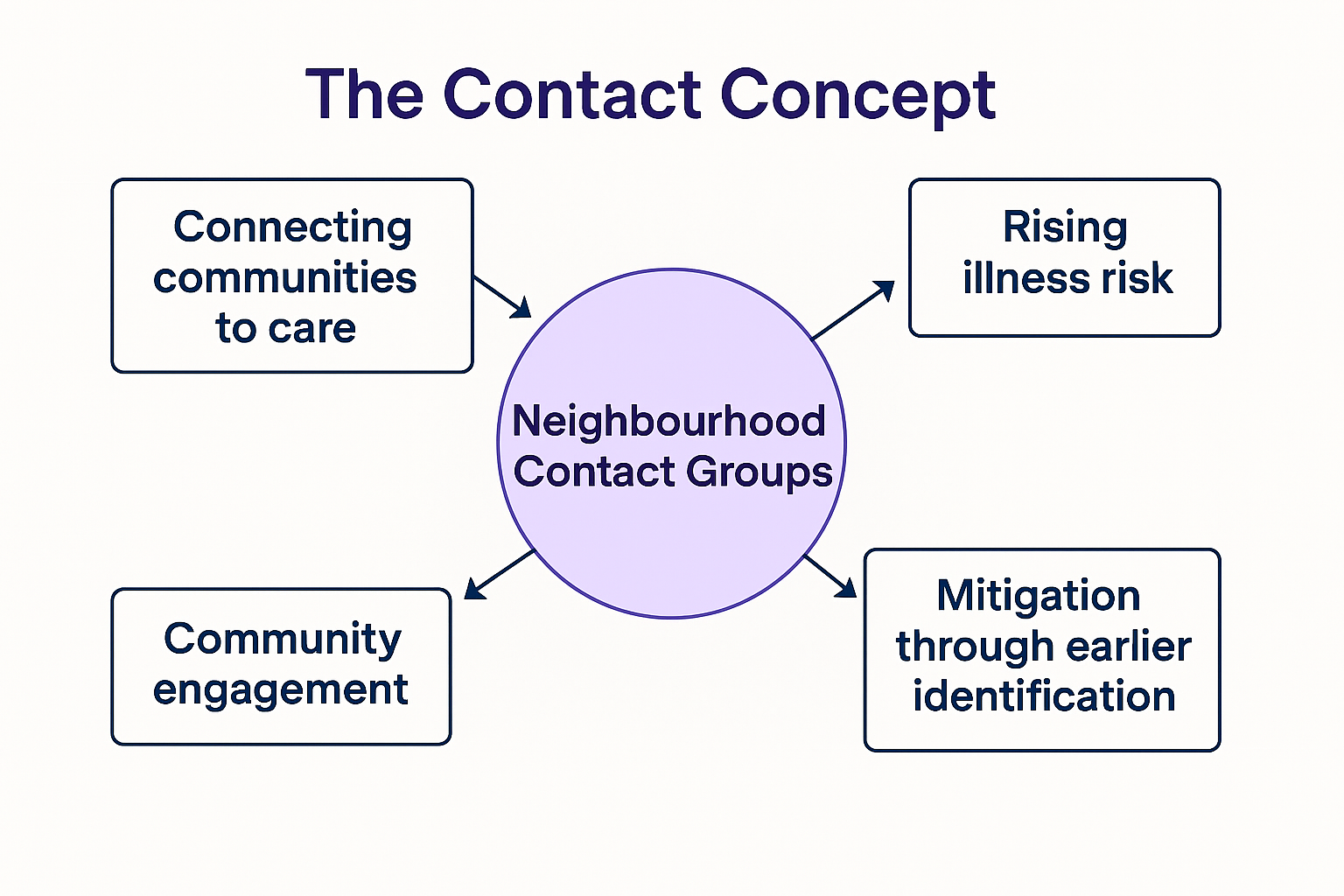
Connecting communities in order to identify and mitigate rising risk of illness.
Across health and social care systems, we are seeing increasing complexity in need. Long-term conditions, frailty, musculoskeletal problems, mental health pressures, and social isolation are combining in ways that mean there is a rising risk of illness which often occurs unnoticed and only becomes visible once people present in crisis, usually to their local Emergency Department.
Integrated Neighbourhood Teams (INTs), particularly through the focus on early identification and mitigation of rising risk of illness, are being designed to respond to this challenge. However, identifying risk early is not something that is easily done and it could be argued that, historical health and social care arrangements have often been structurally ill-equipped to do so effectively.
Collaborative communities often recognise change before formal systems do. That insight underpins Neighbourhood Contact Groups — referred to here simply as “Contact” (on the basis that life is far too short for another three-letter acronym).
What is Contact?
Neighbourhood Contact Groups are locally based forums aligned to local neighbourhoods. Their purpose is straightforward:
To connect communities, enabling prompt identification and action on the rising risk of illness by collective mitigation, and stronger social resilience.
Contact is not another clinical meeting, nor is it a traditional multidisciplinary team (MDT) forum. It does not replace existing health and social care services. Instead, it creates a structured space in which residents, clinicians, care providers, voluntary sector partners, and local leaders come together to share insight, generate coordinated action, and strengthen prevention at neighbourhood level.
Contact’s premise is simple: prevention works best when it is connected, individualised, and relatable.
Why This Matters
Across both rural and urban settings, communities face shared pressures:
- Increasing prevalence of long-term conditions
- Growing multimorbidity
- Social isolation and loneliness
- Workforce pressures within primary and community services
- Escalating demand on urgent and acute care
Risk of illness frequently rises before it is formally recognised by local health services. By the time residents present to a healthcare professional, usually via an emergency department, opportunities for early mitigation may already have reduced.
Lived, relatable, and neighbourhood collaboration often provides the earliest signals of change. Yet this insight is rarely organised or integrated into health and social care systems in a meaningful way.
Contact seeks to provide that structure.
The Three Tenets of Contact
Neighbourhood Contact Groups are centred around three interconnected pillars:
1. Activity
Illness prevention begins with movement, interaction, and engagement.
Contact promotes accessible physical activity, structured wellbeing sessions, and purposeful community participation. Activity is not solely exercise, it is engagement, routine, connection, and agency, all of which are protective factors against rising health risk.
2. Health & Social Care
Contact creates collaboration between communities and neighbourhood health and social care teams.
Residents and local partners can share early concerns and emerging patterns, whether related to frailty, musculoskeletal issues, mental wellbeing, access challenges, or widening inequality. In return, clinicians and care professionals can offer early advice, signposting and providing routes into appropriate support.
Contact strengthens early intervention models by translating community intelligence into coordinated mitigation.
3. Community
Connection can improve health and, more importantly, prevent ill health.
By bringing people together regularly at a neighbourhood level, Contact reduces isolation, strengthens trust, and builds resilience. Stronger social and healthcare-related networks enable earlier informal support, improved self-management, and reduced reliance on crisis services.
Illness prevention is not solely a clinical concept, it is fundamentally social, driven by the environments in which people live and work.
How Contact Works
Neighbourhood Contact Groups operate as:
- Regular, community-led meetings
- Supported (but not dominated) by health and care professionals
- Structured around identifying emerging risk themes
- Focused on practical, local mitigations
- Connected into neighbourhood team escalation routes where needed
- Anchored by partnerships with voluntary and community organisations
The Contact model is deliberately designed to be simple, scalable, and flexible, enabling it to operate effectively across diverse settings, from rural communities to densely populated urban neighbourhoods.
What Success Would Look Like
If effective, Contact would contribute to:
- Earlier identification of rising risk of illness
- More proactive neighbourhood responses
- Increased participation in prevention and wellbeing activity
- Reduced avoidable escalation into urgent and acute care via ED
- Stronger community cohesion and resilience
In essence, Contact seeks to make illness prevention visible and participatory at neighbourhood level.
Contact | The Core Idea
Health risk does not emerge in isolation, and prevention should not either.
Neighbourhood Contact Groups bring together activity, health and social care, and community connection within a single, structured forum. By doing so, they offer a practical way to provide early health and social care intervention while reinforcing something equally important:
Contact.
Contact connects patients with communities of care, combining shared intelligence, activity and human connection to provide and mitigate prompt action on rising risk of illness.
References:
Everett, J.A.C. (2013) ‘Intergroup Contact Theory: Past, Present, and Future’, In‑Mind Magazine, Issue 17.
Rathore, N. (2025) ‘The Fascinating Roots of the Contact Hypothesis’, Psywellpath Glossary.
Zuma, B. (2014) ‘Contact Theory and the Concept of Prejudice: Metaphysical and Moral Explorations’, Academia.edu.
